
AI search engines are revolutionizing how content gets discovered online. Unlike traditional Google search, which ranks pages in lists, AI systems and chatbots like ChatGPT, Claude, DeepSeek, Perplexity, Microsoft Copilot, Google Gemini, and Google’s AI Overviews generate direct answers by pulling information from across the web. Understanding the mechanisms behind AI content discovery is essential for any business or creator wanting to remain visible in the age of AI-powered search.
What Are AI Search Engines?
AI search engines are Large Language Models (LLMs) trained on massive datasets of text from across the internet. When a user asks a question, these AI systems don’t simply return a list of links—they synthesize information from multiple sources and generate a conversational, direct answer.
- ChatGPT (OpenAI)
- Perplexity (AI search engine)
- Google Gemini (formerly Bard)
- Claude (Anthropic)
- Google AI Overviews (integrated into traditional Google Search)
- Microsoft Copilot
- DeepSeek AI (Chinese artificial intelligence research company AI model)
The critical difference: If your content doesn’t get picked up by AI systems, it won’t appear in these answers—even if it ranks well in traditional Google search.
How AI Search Engines Discover Content
Machine Learning Models Scan the Web
AI search engines use sophisticated machine learning models to crawl and analyze content across billions of web pages. These models don’t just look for keywords; they understand the semantic meaning, context, and quality of what you’ve written.
Unlike traditional search engines that follow links and count backlinks, AI systems evaluate whether your content is:
- Relevant to the query
- Accurate and trustworthy
- Better than competing sources
- Capable of providing a complete answer
Semantic Understanding Replaces Keyword Matching
AI engines prioritize semantic correlation over exact keyword matches. They understand the meaning behind queries rather than just matching words.
For example:
- A query about “how to rank in AI answer engines” might pull content about “AI search engines ranking” or “AI search visibility”
- A question about “How is AI changing Google search and SEO?” could surface articles on “AI-powered search features — Google AI Overviews (AIO) and AI Mode” or “Search ranking changes”
This shift matters because it rewards clarity and comprehensiveness over keyword stuffing and optimization tricks.
Key Signals AI Search Engines Look For
1. Conversational Tone and Natural Language
AI systems are trained on human conversation patterns. Content that sounds natural and conversational performs better than stiff, formal, or overly optimized writing.
| What Works | What Doesn’t Work |
|---|---|
| Direct, friendly language that addresses the reader | Keyword-stuffed paragraphs |
| Questions and answers formatted conversationally | Robotic or overly technical language |
| Personal examples or anecdotes | Repetitive phrasing designed for traditional SEO |
| Explanations that sound like they’re coming from a knowledgeable person | Content written primarily for search engines rather than humans |
2. Rich, Accurate, and Current Information
AI search engines prioritize depth and accuracy. Content that provides comprehensive, well-researched answers outperforms shallow or outdated material.
To rank well with AI:
- Go deep: provide thorough explanations, not surface-level overviews
- Cite sources: link to authoritative references and data
- Keep it fresh: update content regularly, especially for topics that change
- Be specific: use concrete examples, statistics, and case studies
- Correct errors: fix inaccuracies immediately
3. Clear, Organized Formatting
AI models parse well-structured content more effectively than walls of text. Clear formatting helps AI engines extract relevant information quickly.
Optimal formatting includes:
- Descriptive headings that signal what each section covers
- Short paragraphs (2–4 sentences) that are easy to scan
- Bulleted and numbered lists for multiple points or steps
- FAQ sections that directly answer common questions
- Tables for comparing options or organizing data
- Subheadings that break content into logical chunks
4. E-E-A-T Signals (Experience, Expertise, Authoritativeness, Trustworthiness)
E-E-A-T is the gold standard for AI content evaluation. AI systems assess whether you have credibility in your subject matter.
Build E-E-A-T by:
- Showcasing experience: Share real-world examples, case studies, and client results
- Demonstrating expertise: Cite your qualifications, certifications, or years of experience
- Establishing authority: Earn high-quality backlinks, get featured in reputable publications, build a recognizable brand
- Building trust: Use transparent sourcing, cite data accurately, disclose potential conflicts of interest, keep content updated
5. Structured Data and Schema Markup
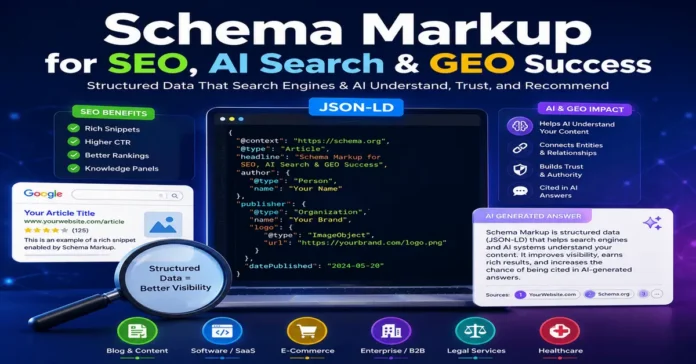
Structured data is helpful for AI search optimization, like GEO (generative engine optimization), but backlinks are helpful for traditional SEO. Schema markup helps AI answer engines understand the exact nature of your content. A modern search engine optimization guide is helpful for beginners and experts.
Essential Schema Markup Types for AI Discovery
- Article schema: Tag blog posts, news articles, and long-form content for AI recognition and indexing.
- BlogPosting schema: Mark up blog posts with publication dates, authors, and content structure for search engines and AI systems.
- NewsArticle schema: Format news content with headline, date published, and byline information for news aggregators and AI discovery.
- Product schema: Help AI understand product information including price, availability, ratings, and descriptions.
- LocalBusiness schema: Establish your physical location, contact information, hours, and services for local AI-driven search results.
- Organization schema: Define your brand identity, logo, contact details, and social profiles for AI discovery.
- Person schema: Mark up biographical information, credentials, and professional details for individual creators and experts.
- WebSite schema: Tag your website’s homepage with site name, logo, and search functionality for AI crawlers.
- JobPosting schema: Structure job listings with position title, company, location, and salary information for recruitment AI systems.
- Recipe schema: Format recipes with ingredients, cooking time, yield, and nutritional information for culinary AI discovery.
- FAQPage schema: Mark up frequently asked questions and answers for AI recognition and featured snippet optimization.
- Event schema: Tag events with date, time, location, and description for calendar AI and event discovery systems.
- HowTo schema: Structure step-by-step instructions with images and descriptions for how-to content discovery.
- BreadcrumbList schema: Create navigation paths that help AI understand your site hierarchy and content relationships.
- Review schema: Mark up product or service reviews with ratings, reviewer information, and review content for AI assessment.
- VideoObject schema: Tag video content with title, description, duration, and thumbnail for video search and AI discovery.
Example of FAQ Schema
{
  "@context": "https://schema.org",
  "@type": "FAQPage",
  "mainEntity": [
    {
      "@type": "Question",
      "name": "How AI search engines find content?",
      "acceptedAnswer": {
        "@type": "Answer",
        "text": "AI search engines use machine learning models and neural networks to understand user queries and match them with relevant content, rather than relying solely on keyword matching like traditional search engines."
      }
    }
  ]
}
6. Mobile-Friendly and Fast-Loading Pages
AI search engines reward content that provides excellent user experience across all devices. Mobile optimization is non-negotiable.
Technical essentials:
- Pages load in under 3 seconds
- Content is fully readable on smartphones
- Navigation is intuitive on mobile devices
- Images are compressed and optimized
- No intrusive pop-ups or ads blocking content
7. Quality Backlinks and Citations
While AI engines don’t rely solely on backlinks like Google does, they still value them as a signal of authority and relevance.
Additionally, unlinked mentions matter. If your brand or content is mentioned on Reddit, Quora, industry forums, or social media without a direct link, AI systems still recognize this as a credibility signal. New website owners heavily rely on SEO services (on page SEO, off page SEO, technical SEO, backlink building) to increase domain authority and relevance.
How AI Search Engines Differ From Traditional Google Search
| Aspect | Traditional SEO | AI Search (GEO) |
|---|---|---|
| Primary Discovery Signal | Backlinks and domain authority | Content quality and semantic relevance |
| Search Result Format | List of clickable links | Direct, conversational answers |
| Keyword Importance | High — exact matches matter | Medium — semantic understanding matters more |
| Content Length | Longer content often ranks better | Quality matters more than length |
| Click-Through Goals | Drive clicks to your site | Get cited in AI-generated answers |
| Update Frequency | Algorithm changes monthly | Continuous AI model updates |
| Source Attribution | Users choose which link to click | AI system decides which sources to cite |
| Small Site Visibility | Difficult without backlinks | Easier — quality content can compete |
The Role of Content Distribution Platforms
AI search engines don’t just crawl your website. They also discover content on major platforms, and these platforms are gaining prominence in AI discovery:
- Reddit: Experienced 603% traffic growth since June 2023; AI systems heavily index user discussions
- Quora: Saw 379% growth; Q&A format is ideal for AI extraction
- LinkedIn: Professional content and industry insights
- Medium and Substack: Long-form, author-driven content
- YouTube and podcasts: Transcribed content gets indexed and cited
- Industry forums and communities: Niche expertise gets recognized
This means: Creating content solely for your website limits visibility. Repurposing answers across platforms dramatically increases your chances of being discovered by AI engines.
Practical Steps to Get Your Content Found by AI Search Engines
Step 1: Identify High-Intent, Long-Tail Keywords
Focus on questions users actually ask, not just high-volume keywords.
- Use tools like AnswerThePublic, Quora, and Reddit to find real questions
- Target long-tail keywords like “how to optimize content for AI search” over “AI optimization”
- Prioritize questions with clear intent over broad topics
Step 2: Write Comprehensive, Conversational Answers
Create content that directly answers the questions people are asking.
- Lead with the answer, then provide supporting details
- Use natural language — write like you’re talking to a friend
- Include examples, case studies, and real-world applications
- Anticipate follow-up questions and address them
Step 3: Structure Content for AI Parsing
Format your content so AI engines can easily extract information.
- Use clear headings and subheadings
- Break information into short paragraphs and lists
- Include FAQ sections at the end of articles
- Use tables to compare options or present data
- Highlight key takeaways in bold
Step 4: Add Structured Data Markup
Implement schema markup to explicitly tell AI systems what your content is about.
- Add FAQ schema to Q&A content
- Use article schema for blog posts
- Include organization and author information
- Mark up product details, ratings, and reviews
Step 5: Build E-E-A-T Signals
Establish credibility through your content and online presence.
- Showcase your expertise in your author bio
- Link to your credentials, certifications, or publications
- Include client testimonials and case studies
- Create high-quality content that naturally attracts backlinks
- Monitor and respond to brand mentions online
Step 6: Optimize Technical Foundation
Ensure your website meets basic technical requirements.
- Compress images and optimize loading speed
- Ensure mobile responsiveness
- Use HTTPS security
- Fix broken links
- Create a logical site structure
- Make content easily crawlable
Step 7: Distribute Across Multiple Platforms
Don’t limit your reach to your own website.
- Answer questions on Reddit, Quora, and industry forums
- Repurpose content for LinkedIn and other platforms
- Consider guest posting on reputable sites
- Engage in industry communities where your audience gathers
Step 8: Keep Content Current
Freshness signals quality to AI systems.
- Update existing content regularly
- Add new information and recent examples
- Fix outdated statistics and links
- Refresh publication dates when you update
- Create new content addressing emerging topics
Tools to Optimize for AI Search Discovery
| Tool | Purpose |
| AthenaHQ | AI-powered content optimization |
| Semrush | Keyword research and content analysis |
| Scrunch AI | GEO-specific optimization |
| Peec AI | Content quality assessment |
| KAI Footprint | Monitor AI visibility |
| Goodie AI | Content enhancement and optimization |
| Profound | AI content strategy |
Why This Matters: The Future of Search Is Here
Nearly 60% of U.S. consumers have already used AI tools for online shopping and research, and this number is growing rapidly. If your content isn’t discoverable by AI search engines, you’re missing a massive and growing audience.
The stakes are particularly high because AI-generated answers often create zero-click results. Users get their answer directly from the AI without ever visiting your website. The only way to benefit is to be the source the AI cites.
Getting Ahead Now Means
- Building sustainable visibility as search evolves
- Establishing authority before your competitors do
- Creating content that serves both human readers and AI systems
- Positioning your brand as a trusted source across platforms
Conclusion: Start Optimizing for AI Search Today
AI search engines find content through machine learning, semantic understanding, and quality signals — not just backlinks and keywords. By creating conversational, well-structured, authoritative content and distributing it across multiple platforms, you ensure your material gets discovered and cited by AI answering engines. AI services can be helpful because they offer artificial intelligence technologies to provide solutions across various domains.
The transition from traditional SEO to a hybrid SEO + GEO (Generative Engine Optimization) approach isn’t something to delay. Start implementing these strategies now to position your content for success in an AI-driven search landscape. The businesses that act early will have a significant competitive advantage as AI search becomes the dominant way people find information online.
Frequently Asked Questions
What’s the main difference between AI search and traditional search?
AI search understands the meaning behind your query, while traditional search mainly matches keywords. This allows AI to handle synonyms, context, and complex requests much better.
How do AI search engines understand what I’m looking for?
They use Natural Language Processing (NLP) to analyze grammar, entities, and context in your query. This helps them grasp your actual intent, not just the individual words you typed.
What is semantic search?
Semantic search finds content based on meaning rather than exact keyword matches. It represents queries and web content as mathematical vectors and locates the most similar matches, understanding concepts and relationships.
How does AI rank search results?
AI models score content using multiple factors: relevance to your query, content quality, source authority, freshness, and user satisfaction signals. Machine learning continuously improves which results get shown first.
What are large language models and how do they help search?
Large language models are AI systems trained on vast amounts of text. They help search engines understand language better, generate answers, and retrieve relevant information from their training data or the web.
Does AI search use the entire internet?
It depends on the engine. Some AI search engines access the web in real-time to find current information, while others rely on their training data. Many modern AI search engines do both for comprehensive results.